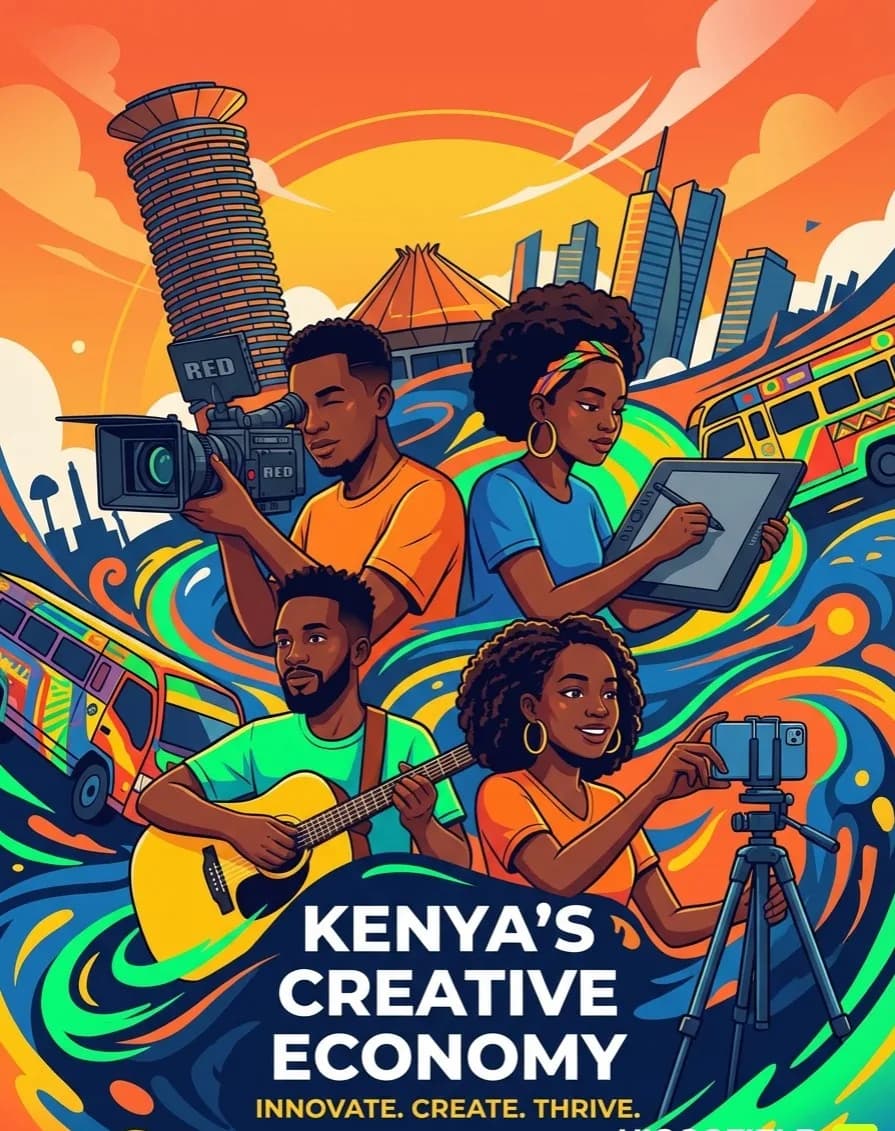
For a long time, the Kenyan dream followed a familiar script: go to school, get good grades, graduate, secure a stable 8–5 job- or not, and build a life from there. Creativity was a side note. Something you pursue after work, on weekends, or not at all. Young people today, however, are rewriting this narrative.
Across the country, more young Kenyans are turning their hobbies into income streams. Content creators, writers, musicians, actors, podcasters, gamers, designers, name them. It is now common to meet a member of a music band who went to law school, or a university graduate making a living from YouTube, TikTok, or beat production. Partly as a response to economic pressure and a generation reimagining what work should look like.
In all fairness, education has come in handy when pursuing these creative spaces. Being able to negotiate brand deals, review contracts critically and look at creativity as an economically viable option are perks we get from being educated. Although our kind of education system does not cater so much for the creative needs of an individual, young people have found a way to navigate this with the little that the system gave them.
Kenya’s unemployment crisis is well-documented. Every year, universities and colleges release thousands of graduates into an economy that simply can no longer absorb them into formal employment. Millions of young graduates are either unemployed or underemployed, surviving on short-term contracts, informal work, or family support.
According to statistics, 60-70% of Kenya’s population is made up of young people. This demographic reality is often framed as a looming crisis, but it is also the country’s greatest asset. Kenya’s youth are educated, thanks to Free Primary Education started by the late President Kibaki, tech-savvy, and globally connected. The challenge, then, is not a lack of talent or know-how; it is a lack of opportunity.
Faced with underpaid, exhausting, and often unfulfilling 9–5 corporate jobs (when they can find them at all), many young Kenyans are asking a simple question: Why struggle in work that drains me when I can earn from something I love?
Monetising Joy
“Do something you love and you will never work a day in your life” may sound cliché, but Gen Z took it seriously.
Why spend depressive hours commuting to an office you dislike when you can spend the day in your room making beats, editing videos, writing scripts, or recording podcasts and make bank from it?
The rise of digital platforms has made this possible. YouTube, TikTok, Spotify, Substack, Instagram and podcasting platforms have opened up global markets for Kenyan creativity.
What’s different now is that creativity is no longer just about self-expression. It is increasingly about income. Kenyans are learning how to package, brand, distribute, and monetise their ideas. Storytelling has shifted from novels and newspapers to music, podcasts, skits, reels, story times on YouTube and long-form video content.
Creativity has become commercial and the creative economy is taking shape. The ecosystem, however, is still catching up to the reality on the ground.
There have been encouraging signs. Last year, the Kenyan parliament proposed policies that would allow musicians to use their music catalogues as collateral for loans. If fully realised, such policies could transform how artists access funding, treating intellectual property as a legitimate economic asset rather than a passion project.
Organisations like HEVA Fund are already doing critical work by providing funding, research and capacity-building for creatives across East Africa. These initiatives prove that creativity can be financed, scaled and sustained. The problem is awareness. Though not many, a lot of creatives are still not aware that these opportunities exist.
If information about grants, funds, loans and creative-friendly financial products were more widely circulated, more young people could turn talents into viable businesses.
Perhaps one of the most underrated changes is happening within households.
Parents who once insisted on “serious” careers are slowly beginning to accept that creative work is real work. When a child can pay rent from photography, animation, writing, or music, it becomes harder to dismiss those as childish dreams. Creative jobs are no longer just hobbies. They are livelihoods.
The Opportunity in the Crisis
Unemployment may be Kenya’s biggest problem but it is also the biggest opportunity.
A job-scarce economy has pushed young people to innovate, to freelance, to build audiences, and to think entrepreneurially. The creative economy will not replace traditional employment entirely, but it can absorb talent, generate income, export culture, and tell Kenyan stories to the world.
What is needed now is deliberate support: better policy, fair digital monetisation, access to funding, and recognition of creativity as an industry. I am not making music as I look for a job; this is the job and it should pay.
The shift is already happening. From the events we have witnessed in the past week on American streamer, Ishowspeed, it is safe to say that institutions and governments are slowly catching up.